As a teacher, I've noticed that there are two types of players. Practice first players and Game first players.
1. Practice First Players - These are players that are really about learning the strokes. They love to practice. They also entertain looking like a pro when they play. They usually join leagues to have something to show for their hard work. But most of the time they don't really care about matches or games. They only care about having professional looking strokes. The matches are full of pressure and momentum. They want to be a tennis player with no stress. So they often have a problem because they don't know what level they are. They say they are a certain level but if you play a match with them they get beaten quickly because they aren't used to stress.
2. Game First Players - These players are the opposite. They love to play matches. They are really competitive and have very little patience for practice. So they rush into the matches. They learn the stokes as fast as possible, sometimes incorrectly, and then try to get into matches immediately. They feel like their worth as a player will increase the more match ready they are. So they can deal with the stress but they have no training. When they get beaten too much they will FINALLY break down and learn something new. But they will barely learn it and jump back into matches right away.
Professionals are like this too. They basically get a coach that will help them develop into a well rounded player.
As a recreational player or maybe a college/pro hopeful you have to acknowledge what type of player you or your child is. Knowing that you will be one of these naturally will help you get the most out of your lessons.
For instance. If you have good strokes and basic technique, then you should get a coach that can teach you how to play tennis matches. Many players will use an hour of time doing drills with their coach then wonder why they can't play in matches so well. And it works the opposite way. A bad technique will leave you vulnerable no matter how many matches you play. You can't just miraculously figure out how to hit pristine strokes without any teaching, research or practice.
It's very important to realize that being a complete tennis player means everything...even the stuff you don't want to do. It's life.

Friday, April 30, 2010


Wednesday, April 14, 2010
Build Up You Arsenal...and USE IT
I have been getting a lot of questions about groundstrokes lately. Make no mistake, if anyone approaches me for a lesson or question, I will normally tell you what is wrong with your stroke first. Here's why:
Depending on how the balls come at you, you have to make a decision of what stroke you want to use. If you only have one stroke for most situations, you will be a very inconsistent player. Thus your ability to do anything else in a point is shortened and there is no reason to teach anything else past strokes if the student can't keep the ball in the court.
As a matter of fact, when an experienced player says that someone has a good stroke. They are more or less referring to the amount of things the player can do with it. Not how hard it is struck.
From a tactical standpoint. As an opponent, if I notice you beat me up with a certain stroke. All I have to do is figure out the situation you like and STOP that from happening. I get a 2 for 1 if stopping the situation ALSO causes you to make unforced errors.
So when I teach, it is my primary concern is to make you comfortable in receiving shots you don't like. Its great to have a shot you can kill but if you can't set that shot up, whats the point in having it?
To drive my point home, I will use world famous Roger Federer although I could have used any player on the tour....or any of my practice partners for that matter.
Here is Roger's regular forehand. Many people use it as inspiration in their own forehand.
 So that's all you need for a killer forehand...Right? But that only covers the forehand from his waist to his chest. You might want to learn how to deal with them around the shoulders.
 But what if you have a really high bounce and it goes over your head?
 What if you have a low bounce?
 What if you can't reach it with a normal forehand and have to slice?
 What if you want to come to the net and you need to hit an approach shot?
 What if the ball is low on the approach shot?
 I won't even get started on the different forehand volleys. Or the backhands, or the serve, or the return of serve, or the slice, or specialty shots. And I'm not exaggerating this. Federer is special but all of the shots I listed are shots you will have to learn if you want to progress in this game. The sooner a club player can realize this, the more dangerous he/she becomes. Good luck!

Depending on how the balls come at you, you have to make a decision of what stroke you want to use. If you only have one stroke for most situations, you will be a very inconsistent player. Thus your ability to do anything else in a point is shortened and there is no reason to teach anything else past strokes if the student can't keep the ball in the court.
As a matter of fact, when an experienced player says that someone has a good stroke. They are more or less referring to the amount of things the player can do with it. Not how hard it is struck.
From a tactical standpoint. As an opponent, if I notice you beat me up with a certain stroke. All I have to do is figure out the situation you like and STOP that from happening. I get a 2 for 1 if stopping the situation ALSO causes you to make unforced errors.
So when I teach, it is my primary concern is to make you comfortable in receiving shots you don't like. Its great to have a shot you can kill but if you can't set that shot up, whats the point in having it?
To drive my point home, I will use world famous Roger Federer although I could have used any player on the tour....or any of my practice partners for that matter.
Here is Roger's regular forehand. Many people use it as inspiration in their own forehand.
 So that's all you need for a killer forehand...Right? But that only covers the forehand from his waist to his chest. You might want to learn how to deal with them around the shoulders.
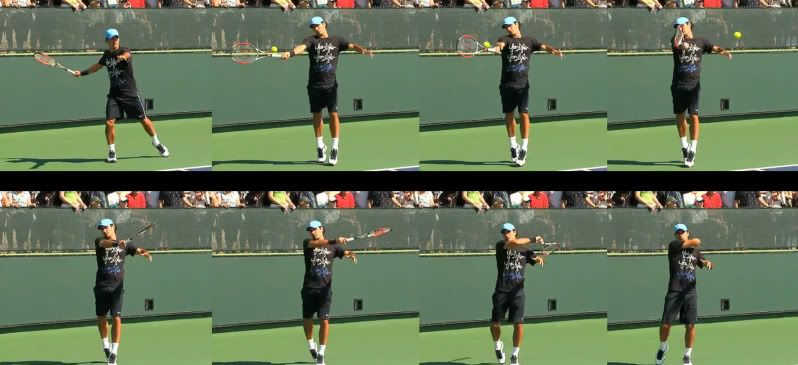 But what if you have a really high bounce and it goes over your head?
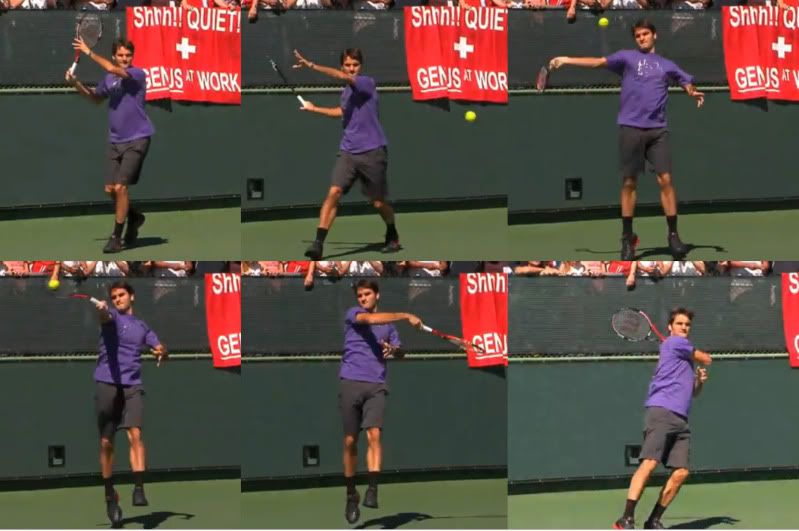 What if you have a low bounce?
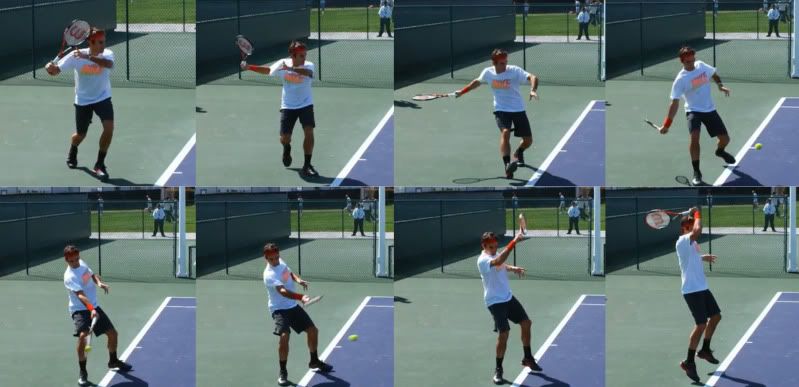 What if you can't reach it with a normal forehand and have to slice?
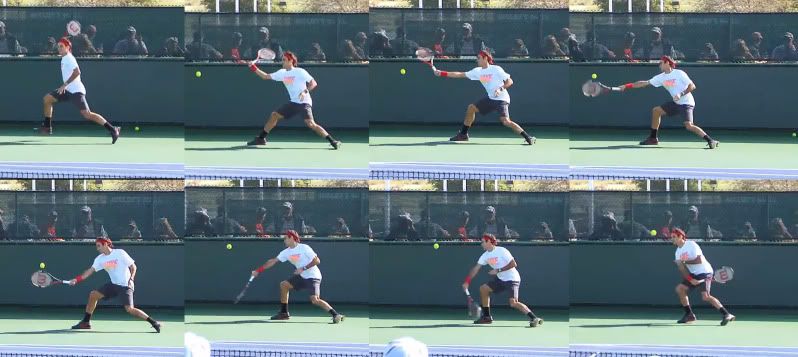 What if you want to come to the net and you need to hit an approach shot?
 What if the ball is low on the approach shot?
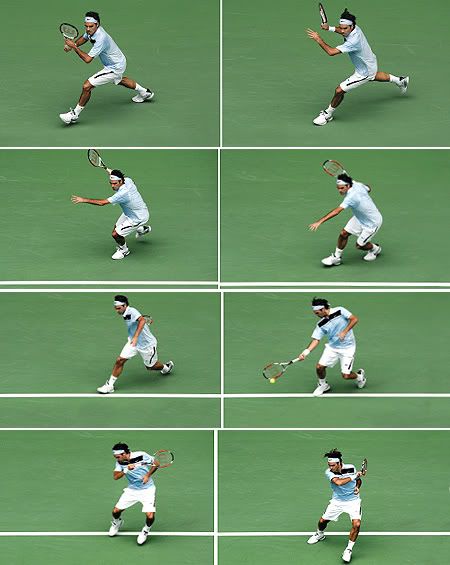 I won't even get started on the different forehand volleys. Or the backhands, or the serve, or the return of serve, or the slice, or specialty shots. And I'm not exaggerating this. Federer is special but all of the shots I listed are shots you will have to learn if you want to progress in this game. The sooner a club player can realize this, the more dangerous he/she becomes. Good luck!
Monday, April 12, 2010
It's Not My Game...It's the Weather (Dry Heat)
First I want to address the issue of pollen. Pollen should only really be a factor if the wind kicks up. If it is humid and heavy, the pollen should not bother you so much. But the dry, hot days with a little wind are what makes it bad. Balls pick up and disperse pollen every time they hit something (IE the ground and your racket) so bring some extra tissues and take your antihistamine.
Dry Heat

Dry heat is killer. You know it's hot mentally. You feel the sun. However you don't seem to sweat. Well you are sweating. But the heat is evaporating your sweat before it beads up and travels down your face.
Dry Heat is bad but if you are the type of player that uses spin or hits the ball really flat and hard, your skills will be magnified. Normally, depending on how hard you and your opponent are hitting the ball, the ball will lose pressure. With dry heat you can enjoy an actively bouncing ball much longer. The balls also stay good for practice as well.
So here is how you beat the dry heat:
1. Hydrate Early - Drink a lot of water the night before if you have a day match and in the morning for an afternoon match. If you are going to drink any diuretics (drinks that dehydrate ie soda/alcohol/coffee) it is more essential to drink water. Pack some extra water and make sure you do not leave it out in the sun while you are playing. The sun will heat up your water just like leaving a dog in a car. Make sure you drink some water every chance you get. If you feel dehydrated then it is too late.
2. Cover up - Unless you are practicing, I think that showing bare arms is a mistake. The sun will hit the exposed areas and will heat you up. The same thing with your head. The body will steal energy from your game in order to cool itself down.
3. Focus - It is a lot easier to become lightheaded when the heat is high. Try to pay attention to how you feel an manage yourself accordingly. If you find yourself getting a little dumber than usual, eat some food, pour a little water on your neck and use the full 30 seconds in between points to towel off and take stock in your condition.
4. Liquid food - Make sure that when you eat food, bring something that doesn't require too much chewing. If you get dehydrated, your mouth will not produce the required saliva you need to break down to food. Bananas are excellent. A non-carbonated sports drink should help. There are some sports pastes that you can use also.
Dry Heat
In 2009, Victoria Azarenka had to play Serena Williams in the Australian Open. At the beginning of the match, Azarenka was firing backhands and forehands and Serena was running all over the place. About midway through the first set, you can see her stomach working hard to pull in air. Azarenka won the first set. Shortly as the match went on, Azarenka started weakly stumbling and almost losing her balance frequently. Eventually she retired from the match. She was ill, and combined with the heat of Australia, she didn't stand a chance.
Dry heat is killer. You know it's hot mentally. You feel the sun. However you don't seem to sweat. Well you are sweating. But the heat is evaporating your sweat before it beads up and travels down your face.
Dry Heat is bad but if you are the type of player that uses spin or hits the ball really flat and hard, your skills will be magnified. Normally, depending on how hard you and your opponent are hitting the ball, the ball will lose pressure. With dry heat you can enjoy an actively bouncing ball much longer. The balls also stay good for practice as well.
So here is how you beat the dry heat:
1. Hydrate Early - Drink a lot of water the night before if you have a day match and in the morning for an afternoon match. If you are going to drink any diuretics (drinks that dehydrate ie soda/alcohol/coffee) it is more essential to drink water. Pack some extra water and make sure you do not leave it out in the sun while you are playing. The sun will heat up your water just like leaving a dog in a car. Make sure you drink some water every chance you get. If you feel dehydrated then it is too late.
2. Cover up - Unless you are practicing, I think that showing bare arms is a mistake. The sun will hit the exposed areas and will heat you up. The same thing with your head. The body will steal energy from your game in order to cool itself down.
3. Focus - It is a lot easier to become lightheaded when the heat is high. Try to pay attention to how you feel an manage yourself accordingly. If you find yourself getting a little dumber than usual, eat some food, pour a little water on your neck and use the full 30 seconds in between points to towel off and take stock in your condition.
4. Liquid food - Make sure that when you eat food, bring something that doesn't require too much chewing. If you get dehydrated, your mouth will not produce the required saliva you need to break down to food. Bananas are excellent. A non-carbonated sports drink should help. There are some sports pastes that you can use also.
Sunday, April 4, 2010
It's Not My Game...It's the Weather (Cold)

If you are like me you will play tennis in the cold even if you do not like it. Cold weather takes bounce out of the ball. So if you are used to hitting the ball with a little pace, you can forget about it.
The cold weather also can freeze you making it harder to warm up and easier for you to get injured. No fun there!!
BUT you are addicted to tennis or maybe you signed up for a league and you do not want to quit so here is how you overcome the colder temperatures.
1. Get out the long johns! Most people naturally want to layer their clothes to keep warm. I try not to layer so much. Personally I put on long underwear pants to warm my legs up quickly. I do not want to wear shorts because I do not want a changeover to take all the warmth out of my legs for the next game.
For the top half of my body I wear a tight shirt underneath and maybe a sleeveless undershirt. Then I put on a big sweatshirt. I don't want to layer so much up top that I sweat or stifle my swing motion in some way. I am a big guy and this is how it works for me. However, if you are a different body type, you might not have a problem hitting a forehand or a serve. So experiment. However I do STRONGLY recommend not exposing any skin to the elements if you can.
2. Spin works wonders. You want to play with the spins more than usual. Slice serves and flat serves are good. The ball will not bounce enough for anyone to be very aggressive so do not worry so much about people hitting winners. Keep the shots low and you can take all the patience out of an aggressive player.
3. Get to the net. The most aggressive shot you can hit in this weather is your serve. So if you can get to the net behind it you could have some success. Go more for angles on your groundstrokes when you hit an approach shot. Smacking balls deep will cause you to overcook shots.
4. Bring something warm to drink.
The cold is something that we all have a preference about. with a little experimentation you can keep your condition stable and play at an optimum level.
Good luck!
Subscribe to:
Comments (Atom)