Wednesday, December 29, 2010

Different Body Types (Skinny)

When I say skinny, I mean even. I can't remember someone that is very muscular that is not top heavy. Usually the skinny ones are equal all over. Skinny players have flexibility on their side. Without a lot of weight fighting them, they can move and recover faster than most people which makes them a very strong defensive threat as you would have to hit 3 or four good shots to get a winning shot off of them.

Gilles Simon
6 ft 154 lbs (Soaking WET!)

Their weakness, of course, lies in strength. As they are gifted with a body that can pretty much do everything equally, they don't have the strength to hit too many killer strokes for a long period of time.

Groundstrokes

This is my oppinion. I think that skinny people do very well with hitting flat shots. It takes the least amount of energy to hit a flat shot well and it is easier for a skinny person to stay on balance. Also they are able to twist their waist enough to get a good hit off of any ball.


Kei Nishikori
5"10" 150 lbs

Serve

Since a skinny person is not that strong. They have to utilize flexibility on their serve. Whatever motion they have needs to be pretty stretched out so they can gain more momentum. A loose serve for them is better than a muscled one.

Volleys

Like groundstrokes, skinny people will get to the ball. They might have some problems if a strong ball is rocketed towards them. If their wrist wobbles on contact, the result will be a sitter for the opponent. It is very important for a skinny person to hang in there and get the balls back as much as they can.

Footwork

Skinny people naturally have pretty good footwork. They seem to float from corner to corner. This will be the main feature in their arsenal: Cardio fitness and marathon type footwork. So hustle should be a given for all times because they have less chances of being injured. Some ankle strengthening exercises would be helpful though at higher levels.

Injuries

I've noticed that skinny people tend to injure wrists and ankles and maybe some elbow strain. The more flexible you are, the less your muscles protect your ligaments. ESPECIALLY past a certain bending point. So make sure you target these points in your workouts.


Venus Williams
Wrist Surgery!

Being skinny is a great body for starting tennis. Since consistency is paramount in lower levels a skinny person have retrieve balls all day. But when the levels get higher and people get stronger, skinny people need to learn how to counter other people's strengths by out hustling them.

Good Luck!

Wednesday, December 15, 2010

Different Body Types (Top Heavy)

The different body types of a person can clue you in to how the person plays. Professionally the body types are pretty similar. There are very subtle differences. In the world of regular people playing tennis however, you will encounter MANY different types that range from extremely top heavy to extremely bottom heavy. These difference DO effect the play. We will start off with top heavy and work our way to bottom heavy.

TOP HEAVY

Jo Winfried Tsonga, Andre Agassi

Top heavy players are, of course, players that are more built up top than at the bottom. Big shoulders, wide chest, maybe a belly, strong upper legs and small lower legs. As people get older, they get more muscles. Thus, they become slower and more inflexible but stronger. It happens to many players.

The key weakness of top heavy players is balance. Biomechanically speaking, a top heavy person has a higher center of gravity. Having more weight up top makes it easier for the body to fall. This puts more strain on the lower joints. So top heavy people need to work on their legs in the weight room to make sure they can support the top part of the body. OR you can lose weight in the top. If you can do both without losing too much muscle that would be ideal.

The key strength of top heavies is strength. Being naturally strong will allow you to hit a harder ball longer and give you the opportunity to be aggressive even when you are off balance. Thus giving your opponent something to thing about when they have you running.

Groundstrokes

In groundstrokes, top heavies should look to be the aggressor in rallies. If you are the strongest on the court in singles and the game is long, being the aggressor can help wear the other person down. If the opponent is playing above his/her game level to keep up with you, it will surely show by the middle of the second set.

Serve

Top heavy players can muscle the ball in. But the trick is to learn how to lean into the shot. If you have a fast serve, leaning into the ball can turn it into a bomb that knocks rackets out of someone's hands. Jumping into the serve is ok but when you are big up top your legs can wear out over the course of time. So save the big knee bend for the big points.

Serena Williams changes her knee bend based on the situation.

Volleys

Assuming that the top heavy person doesn't have clumsy footwork they should be very good at volleys. Strong wrists, stable body and small bursts of leg speed really give these people an advantage. The ELASTICITY it takes to snap back from a STRETCH VOLLEY(.com) is where a top heavy person loses ground. Depending on how top heavy the person is, they might have problems getting back in the court.

Footwork

With small calfs (lower legs), Matches with long rallies can wear out a top heavy person. The ability to hit the shots is there. The ability to MOVE to the shot might not be. The split step gets PUNISHED. And with it goes the movement you need to jump toward the ball early. Fortunately you might still have enough strength to hit the ball with topspin and buy yourself some time so your footwork doesn't have to be GREAT.

The top heavy player is a physical specimen that should look to be aggressive about 70 - 80% of the time. Look to wear down with strength. You have it so you might as well use it.

Monday, November 1, 2010

Different Strokes for Different Folks (Style of Teaching)

As a tennis pro, I've never had anyone ask me "What style of teacher are you?" This is a very valuable question because teaching styles vary so much. If you pick the wrong teacher, you might not get better like you want. This blog will highlight some of the pros and cons of each style.

1. THE HITTING TEACHER - This is the teacher that just takes you out and has you hit balls. His big goal is to get you consistent enough so that he can hit with you. Most of these players are baseliners. They keep the lesson moving at an accelerated pace, they don't miss shots and usually were collegiate players.


Pros - These teachers can sharpen up your consistency and footwork. The sense of accomplishment after hitting with a pro like that makes you feel like a really high level player. You will get to hit plenty of balls in the lessons without much talking.

Cons - The hitting teacher might be so concerned with keeping the balls in play that they do not see what you are doing wrong. So if you ask them questions, you might get a really generic answer like "follow through on the shot." If you are looking for reasons why you lose mentally, they might not be able to go there with you.

The best time to come to them is after you learn a solid foundation and technique in singles and in group sessions.

2. THE FEEDER TEACHER - They stand close to the net and feed balls, making comments as they are feeding. You don't have much time to think. You just have to DO. They are VERY demanding and after the lesson you are COMPLETELY spent.


Pros - These teachers are good at finding another level in your hitting ability. Their drill sergeant style lifts you up and pushes you beyond the skills you never thought possible. They are great for hand/eye coordination.

Cons - Once you learn all the techniques, that's pretty much all their is to it. Many times the teacher can hurt your feelings with their sharp comments. Once they get in the groove of feeding balls, they might start to mechanize and you will not get a chance to think about what they said. Sometimes their drills have your brain moving fast and it is hard to slow it down for matches.

The best time to come to them is the very beginning of your tennis life and group sessions.

3. THE TECHNIQUE/STRATEGY TEACHER - This teacher knows how to do everything with a racket and wants to teach you. They see EVERYTHING and know exactly why you might have a problem. They have a great deal of tennis smarts and keep up with the latest techniques.

Pros - You come out of the lesson more knowledgeable. You learn the skills and why they are important. They seem to be interested in you as a person and try to treat you as an individual.

Cons - They are very talkative. Most are aware and some cannot help it. If you pay for an hour, you might have to keep them on task as they might lose track of the time or start talking too long. In addition, these teachers can also hit with you but only up to a certain level. They are bound to make more mistakes than the hitting teacher.

The best time to come to them is once you are ready to level up your mental game and strokes or MUCH later when all you need is game plan advice.

I'm not saying that any of these teachers cannot do the other's job. As certified professionals they all have proven their skills in a variety of areas. But once you get the teacher in their element, you have just maximized your type of lesson.

Next....the collegiate teacher vs the recreational teacher.

Wednesday, September 22, 2010

Davis Cup and Fed Cup

The two tournaments you don't hear too much about but are very famous are the Davis Cup and the Fed Cup.


The Davis Cup (men) and the Fed Cup (women) are played all year round. Whenever the tennis pros have a break from their super busy schedule, they gather up with their teammates and host or visit another country. That is as simple as it gets.

Tournament Format

There are 8 teams in each side of the draw (16 total). You DON'T want to know how they chose the 16...TRUST ME. It's like talking to a lawyer about a contract. Something about a round robin format and zones like world cup.

But after they get the teams...it is a normal drive to the end of the tournament. A committee figures out where the ties are played.

What the heck...TIE?

When two countries play each other, they call it a "tie." This messed me up for a very long time so it is really important to understand that.

In a tie there are 5 matches, 4 singles and 1 doubles over 3 days (friday - sunday). Friday, 2 singles matches are played. Saturday is for the doubles match. Sunday, the 2 more singles players play.


Every match is called a "RUBBER." So if USA wins 3 out of 5 Rubbers against Sweden, USA wins the Tie. If USA wins the first 3 right off the bat, the last two rubbers don't matter but they still are played. Those matches are known as "DEAD RUBBERS."

Why is Davis/Fed Cup Fun?

Well DAVIS/FED CUP is like a big party. Fans are allowed to make as much noise as they want in between points and are often VERY ROWDY. The players also really seem to enjoy playing for their respective countries. Sometimes the home team has crazy rules like unlimited shot tracker challenges.


Players that feed off atmosphere can become davis/fed cup heroes. Nobodies can make a great name for themselves. A lot of people really love to play for their countries and are really motivated.

Monday, September 13, 2010

The Hard Courts

Hard courts are the most used courts in the US. Two slams use hard courts:

The US OPEN


The AUSTRALIAN OPEN


Hard courts offer the most true bounce. That means that you can guess where the ball will go after the bounce easier than clay or grass. At he US OPEN, the lines on the court are painted with a more reflective paint so that the fans can see the lines much easier at night. This paint changes the bounce slightly and gives players problems. Especially if the player likes to stand very close to the baseline.

Hard Courts, any type of courts for that matter, can be sped up or slowed down. The more layers of court they put on the concrete before painting it, the slower the court. So if you see a court so worn out that you can see concrete, expect your serve to be slightly better.

Cracks are another thing that effect hard courts. Architects think it is nice to have courts surrounded by trees to offer a little shade. But underground the trees roots can cause cracks. Crack can cause some crazy bounces.

The hard court season is usually the most grueling season in tennis because, as a trade off for the true bounce, tennis courts are really hot. If it is 90 outside, it is about 100 - 110 on the court depending on how hard the sun it beating. Shoes wear out much faster and shade is a commodity that you will welcome in lieu of the cracks. Most ALTA and USTA teams that practice in the evening can be affected by the daytime matches this way.

There is not much of a difference between the two major tournaments though. It is quite a bit hotter in Australia most of the time during the tournament. The US Open courts play faster. The fans in both tournaments are pretty rowdy. For some reason Serbians start fights at the Australian and at the US, our own US players seem to get ripped apart by linesmen with bad or disputable calls.

Hard courts are the easiest courts to learn on because, in the US, anyone can find them and play on them for free. It is one of the things that makes the USA great (in my opinion) so go to a hard court this week and swing some rackets...FOR FREE.

Sunday, August 29, 2010

To Grunt or NOT to Grunt

In the 90s grunting became popular because of Monica Seles. People grunted before but not LOUDLY.

http://nbcsportsmedia4.msnbc.com/j/msnbc/Components/Photos/051227/051227_seles.hmedium.jpg


Then more and more people started doing it. If you are an avid tennis watcher you have heard grunts. Mostly on the ladies side, but men grunt as well. I've heard blood curdling shrieks, grunts that sound like you are punching someone, grunts that start before you hit the ball, grunts that sound like "MMMMMUUUUUUUH" or "HEEEEEEEEEY." What is the point???

Grunts help you do a few things...
1. They help keep your timing of hitting the ball
2. They help you hit harder and through the ball more consistently
3. They help you scare the living mess out of your opponent (INTENSITY!!!...COME ON!!!!)


What sucks about grunts is that...
1. They wear out your cardio
2. They are outright ANNOYING
3. They are not good for volleys or touch shots
4. If you get your picture taken, you look really silly


All types of players grunt. Personally, grunting gets my energy up. If the other player is hitting the ball well enough that I need more footwork and racket speed than usual, I'll grunt. I would prefer to use the pace and not have to scream. You can get the job done strong and silent or strong and loud. Either way is intimidating.

Saturday, August 14, 2010

Why Ultimate Tennis is BAD

Ultimate Tennis AKA KSWISS is a tennis league in GA. It is the most popular one around. As an adult, you play singles. One match a week, 6 weeks. At the end of the 6 weeks, depending on how well you did, you play in the playoffs. Pretty simple.

The good thing about it is that they are popular so you can play many different people in your league. EVEN THOUGH you live in the same place you opponents will change. Plus you don't have to travel too far for matches. I mean if one guy in Riverdale signs up and the closest people are in Atlanta, it sucks that everyone in the division has to drive 30 minutes to get to this one dude everytime he has a home match. Most people suck with directions and live in hard to find places.

The problem that I have with Ultimate Tennis is the system that they have for moving up in skill level. I started at 2.5 beat everyone and moved up to about 4.0- and lost interest.

4.0-....yes Ultimate tennis has 2 skill levels in every skill level. Instead of just splitting the groups in half and having a final for the two halves at the end. They chose to say "well we will make two different levels: a level that sucks and a level that is good." They stole the rating system from USTA which defines what skills you should have to be a certain type of player. But then they split that up. So instead of 3 4 5 6. you have USTA 3 3.5 4 4.5 5 etc. and Ultimate 3- 3.0 3.5- 3.5 etc. It burns me up when you are asked what level you play and you have to say MINUS because you play in ULTIMATE. It's all a ploy to make you play twice as many levels for $35 a season. Which is hugely expensive.

The second problem is that I have played ultimate tennis since 2.5. Moving up is HARD...which I will talk about later. But you could look off that ratings sheet and say "hey, I'm a 3.5" and bam you are that guy. And if you are that good that is fine but I could be as good as you and stuck in 3.0 for a while. Half of my seasons a few times were RIDDLED with guys that never played a match before....EVER. I don't want to tell my opponent how to play at 3.5 level.

The third problem is excruciating. You have to DEMOLISH people to move up. I mean you have to beat everyone, have one three setter, AND take down a guy like 6-0 6-2. If one of your guys was a substitute, the points don't count. Sometimes they give you the benefit of the doubt. sometimes not. I think that if you beat EVERYONE or maybe lost one match in a close 3 set match, you should move up.

There are so many leagues in GA. So try some out. League tennis, Peach Tennis, USTA, T2 Tennis. Smaller leagues tend to have more diehard tennis players. They are cheaper and need more people. Especially JUNIORS.

Sunday, July 4, 2010

What Speed Do You Play

Regardless of what type of player you are (all court, serve and volley, aggressive baseliner, or defensive baseliner), all players have a pace that they are comfortable with. In this blog we will look at the three different types of pace and what this means to you.

The Slower Pace Player

http://betting.betfair.com/tennis/CarolineWozniaki.JPG
Caroline Wozniaki


The slower pace player is a really important type of player to deal with simply because it takes less technique to slow a ball down than it does to speed it up. A slower pace player doesn't have to have good footwork, he usually just needs to get to the ball. They also do not need to learn a full stroke. Even if they did, they would slow the swing down in mid stroke anyway. Because of the nature of a slower pace player, they have more time to think about placement and different type of spins. At lower levels, the players just tap balls back. as a level gets higher and higher, the slow pace of play learns new tricks learn how to slice, they learn how to hit moon balls and they learn better footwork. All are tactics designed to extend points and keep them in rallies to test your patience.

The Faster Pace Player

http://www.wimbledon-tennis.com/wp-content/gallery/wimbledon-2009/elena-dementieva.jpg
Elena Dementieva


The faster pace player is more impatient than the slower pace player. Most of the time they are hoping that the pace can be sped up in the rallies so that they don't have to think about the technique. Often faster pace players do not understand why they don't like to play against slower pace players. So once they understand that they can only speed up the pace a little more than the slowest pace on the court they can win matches even though they're still not having fun. At lower levels faster pace players just hit the ball flat (no spin). But as they get higher in levels they correct their technique and learn how to place balls well even when they can't hit it that hard.

The Mixing Pace Player

http://www.justinehenin.info/uploaded_files/photo_gallery/800px-Justine_henin_hardenne_medibank_international_2006_02.jpg
Justine Henin


Certain players are adept to using a variety of spins to speed up and slow down the pace. They can use whatever pace their strategy dictates. However, some of these players have too big an ego to play slower than the other player and sometimes that causes them to lose matches.

It is very important to understand that no matter what pace you play at, the slower pace player dictates the speed of the rallies. The faster pace you want to play the harder it will be to keep up that pace unless the opponent obliges playing at the same around the same speed. So if you find yourself making a lot of mistakes in rallies that you don't normally make, ask yourself if you need to slow the pace down or speed the pace up and make adjustments.

Tuesday, June 15, 2010

The Grass Courts

http://upload.wikimedia.org/wikipedia/commons/c/c3/Wimbledon_Court_1.jpg

Grass court season has started. All the tournaments are building up to the Grass Court slam Wimbledon.


Wimbledon is in England and it is, in my opinion, the most prestigious slam of all the slams. WAY BACK in the day, all of the slams were grass courts. Then one by one, they all changed their surfaces. Wimbledon is the ONLY slam out of the four that still uses grass.

So all tennis players have a dream to win Wimbledon. The history, the legend...blah blah blah. I have to admit, if I was a player of that caliber, I would want to win Wimbledon too. Even though I like hard court tourneys more.

But there is a lot to grass courts that distinguishes them from the other surfaces that are really hard to see when you watch.

1. Every court is unique. By that I mean like any lawn, there are inconsistencies. A dip here, a dead spot there. So you always have to look and pay attention to the bounce. Like clay courts except the bumps are hidden. The top players at Wimbledon always have the advantage because the play on centre court EVERY TIME. So they KNOW the court. Court 2 is called the "Graveyard court" because once a champion player gets old, the tournament directors stick him on that court in hopes that he will lose due to unfamiliarity.

2. Courts get worn. everyone plays on the court for 2 weeks straight. Eventually the grass becomes DIRT. Especially at the baseline. Some players lose their footing in horrible ways. Watching players fall in Wimbledon makes you glad that they are flexible.

3. The bounce is low. With clay the bounce is high, but grass has a low bounce. So this means that your back will hate you in the morning. Depending on the way you hold your racket when you hit shots and how tall you are, you will either have a fairly comfortable tournament or a need treatment after every match.

4. Loose net cords. In England, it rains A LOT. So there is a special team of people that roll out the tarps and save the courts from being soaked. They have to pull out the net first so they keep it loose. This means that when you hit a ball and it clips the net cord, the chances of it rolling over to the opponents side is 70% or so.

With these factors, you can see how grass courts benefit shorter baseliners, good servers, people who hit a generally flat ball, and good volleyers. If you have a good serve and volley technique, you can go pretty far. Your serves will stay low, you don't have to deal with the unsure bounce when you are serving, and your volleys will also stay low.

They have slowed the grass courts since 2010. Meaning that the ball bounces a little higher giving you more time to hit the shots. So all sorts of players have a chance to win.

Monday, May 17, 2010

The Clay Court Surface

The French Open is coming on the 23rd. That means the racket bracket is that weekend. The racket bracket is where you make your picks for who you think is going to win. So I thought that it would help to explain the different courts for the slams just to broaden understanding.

Clay Courts
http://www.tenisportal.si/uploads/Image/clay%20courts.jpghttps://blogger.googleusercontent.com/img/b/R29vZ2xl/AVvXsEi0ukOgf7REdaJ3-dSl8LN5LGJkwAwd8Rc6H0xgphPYcwRDqPnkxzV5kwLPMoNzz7jzbYwF8skW2cdQyADLp8odB7uGe0kjF4B0bCbokSRYWau6u2mKcR4DfQlKeeMBXukogC6b5pKnLCem/s400/delray+beach+001.jpg
Clay courts are the most special of the 4 types of courts. It takes more maintenance. The surface is a relatively soft. And there is clay spread out on top. In America, the courts are grey or greyish green. I'm EUROPE, however the courts are red. The mixture of the clay is up to the manufacturer but the red stuff has some old bricks ground up into sand. The courts are sometimes bigger for more running space.

Because of this, clay courts are the slowest courts. They favor the most patient, the most balanced movers and the most well conditioned.

The ball normally bounces higher and can bounce crazy depending on the condition of the court. Whatever spin you put on the ball with magnify in the bounce. Topspin will jump more violently, underspin will stay low etc. The boundary lines are nailed into court which makes them raised slightly. When the ball bounces off the line, it can bounce unpredictably. It can also bounce funny off any spot that clay is accumulated.

The advantages of clay is that it is easier on the body. The joints do not get the same pounding as with hard courts. And the clay leaves marks where the ball landed. So you know (unless the opponent hits the ball very weakly) if the ball was in or out based on the bounce and the mark.

ANY type of player can be great on clay though. You just have to use the flow and not fight it. One thing is for sure, clay is for long fights.

Counterpuncher
https://blogger.googleusercontent.com/img/b/R29vZ2xl/AVvXsEhSvtOYkuHBw2D3ZBETr-kx9BAt8MngiDcWnxFKm05hIWPsmM7huS_8dZxQ56nxR-bpcTOdCN5Bs8U27Uu3rqcwfOercqUvm8uQLyA3n9F_ir_ffVl36nWsEUm5b6LU-nARw4G8wPnnxZc/s400/nadal+clay.jpghttp://img.skysports.com/09/05/800x600/Jelena-Jankovic-French-Open-2009-rd-2_2311733.jpg
Rafael Nadal and Jelena Jankovic

The counterpuncher uses the slowed pace and the higher bounce to give them time to play defense. Running everything down, sliding everywhere and making sure to extend the rallies. The counterpuncher on clay gets a bonus if they have a weapon that can wear people down. like a heavily spun topspin forehand or a full mixture of shots. Wear out everyone.

Powerhitter
Robin Soderling of Sweden hits a forehand during his Men's Singles Third Round match against David Ferrer of Spain on day six of the French Open at Roland Garros on May 29, 2009 in Paris, France.  (Photo by Clive Brunskill/Getty Images) *** Local Caption *** Robin SoderlingSerena Williams of USA hits a backhand during the Women's Singles Quarter Final match against Svetlana Kuznetsova of Russia on day eleven of the French Open at Roland Garros on June 3, 2009 in Paris, France.  (Photo by Clive Brunskill/Getty Images) *** Local Caption *** Serena Williams
Robin Soderling and Serena Williams

The powerhitter uses the extended rallies to make the opponent run A LOT. Whatever weapon they have, they want to hit it all day. Sometimes you see them running all over the court trying to hit a forehand ALL THE TIME. Overpower the powerful, wear out the weak.

Serve and Volley
http://dailychuckle.typepad.com/.a/6a00e54ee7a84388330120a8bbb42c970b-400wi
Michael Llodra
The serve needs to have variety. Since the power will be dulled by the surface, a good spin serve is essential. It really depends on your opponent. The volleys will be a lot nicer when they hit the floor and you will have longer to get to the net. Overwhelm your opponent.

All Court Player
Roger Federer of Switzerland stretches for a forehand during the Men's Singles Quarter Final match against Gael Monfils of France  on day eleven of the French Open at Roland Garros on June 3, 2009 in Paris, France.  (Photo by Ryan Pierse/Getty Images) *** Local Caption *** Roger FedererSvetlana Kuznetsova of Russia poses with the trophy following her victory during the Women's Singles Final match against Dinara Safina of Russia on day fourteen of the French Open at Roland Garros on June 6, 2009 in Paris, France.  (Photo by Ryan Pierse/Getty Images) *** Local Caption *** Svetlana Kuznetsova
Roger Federer and Svetlana Kuznetsova

Constructing points is the key as usual for the all court player. So whatever type of play he/she does, he can use it to get to the net and take time away.

Clay Courts For You
When you play on clay, remember a few things:

If it rains a little, its OK as long as there are no puddles.

At most places, is customary to prep the courts for the next players when you finish your match.

If someone chooses clay on purpose, most of the time they are doing it to mess you up.

Use soft court balls on clay. I carry a can just in case my opponent does not have one.

If you want to learn about technique on TV. Watching clay court tennis is the way to go.

Tuesday, May 4, 2010

Finding the Zone

The zone is an elusive place. It is the place that you find in any sport where self realization leaves and you just play well. It seems like whatever you want to do you can do it. That 100 mph running forehand down the line, no problem.


The in between the legs winner passing shot you always wanted to try, why not?
That down the line shot from out wide that goes around the netpost, who loves ya baby!


The Zone is different from momentum because when momentum shifts one person plays better and the other worse. In the Zone, it doesn't matter how well the other person plays, unless they are in the zone too.

One thing is for sure, you can't be amazing all day. Fortunately in tennis, if the zone lasts for 20 minutes, you will be off the court pretty fast. Two problems with the zone. Getting there is very difficult. And dealing with it when you leave is harsh sometimes. So lets look at those two cases examples.

Getting there - The best you can do to get to the zone is concentrate. If you make enough successes in a short amount of time, your confidence might get pushed into overdrive...MIGHT. Concentration means paying attention and focusing on the task at hand. No jokes, no commentary to yourself, just think about your plan and execute. At some point, you will have executed the plan so much that you can do it without thinking. If a few more things fall in place (weather, good relationships, health), the zone will occur.

Being there - Once you get there everything will fall in place. Ride the zone as much as you can for as long as you can. While you are there though, it doesn't hurt to let your opponent know how great you are feeling...indirectly. Later on in the match, you can duplicate this behavior when you are just playing well and not in the zone and you might scare the mess out of him/her. A really offensive bully type player might crumble. It might not work so well if the player really loves a good fight (like me).

Falling out - When you fall out of the zone it is rough. It's like losing all your money in a gamble, you just didn't see it coming and now you have to regain your poise and start again.

The big problem many people have is that they place their value as a player on how they play in the zone and not how they play when they are having problems. So when they hit the zone they say "now I'm playing like I NORMALLY play." Once they fall out of the zone they spend their whole match trying to find it again or "play normal." The problem is that they put way too much stock on how well they play and go for more shots instead of working their way slowly back up to the zone. So next time you fall out of the zone, back off a little on your shots to find how confident you are and work your confidence up again. You might not find the zone again, but at least you won't make as many unforced errors.

Friday, April 30, 2010

Do what you don't like

As a teacher, I've noticed that there are two types of players. Practice first players and Game first players.

1. Practice First Players - These are players that are really about learning the strokes. They love to practice. They also entertain looking like a pro when they play. They usually join leagues to have something to show for their hard work. But most of the time they don't really care about matches or games. They only care about having professional looking strokes. The matches are full of pressure and momentum. They want to be a tennis player with no stress. So they often have a problem because they don't know what level they are. They say they are a certain level but if you play a match with them they get beaten quickly because they aren't used to stress.

2. Game First Players - These players are the opposite. They love to play matches. They are really competitive and have very little patience for practice. So they rush into the matches. They learn the stokes as fast as possible, sometimes incorrectly, and then try to get into matches immediately. They feel like their worth as a player will increase the more match ready they are. So they can deal with the stress but they have no training. When they get beaten too much they will FINALLY break down and learn something new. But they will barely learn it and jump back into matches right away.

Professionals are like this too. They basically get a coach that will help them develop into a well rounded player.

As a recreational player or maybe a college/pro hopeful you have to acknowledge what type of player you or your child is. Knowing that you will be one of these naturally will help you get the most out of your lessons.

For instance. If you have good strokes and basic technique, then you should get a coach that can teach you how to play tennis matches. Many players will use an hour of time doing drills with their coach then wonder why they can't play in matches so well. And it works the opposite way. A bad technique will leave you vulnerable no matter how many matches you play. You can't just miraculously figure out how to hit pristine strokes without any teaching, research or practice.

It's very important to realize that being a complete tennis player means everything...even the stuff you don't want to do. It's life.

Wednesday, April 14, 2010

Build Up You Arsenal...and USE IT

I have been getting a lot of questions about groundstrokes lately. Make no mistake, if anyone approaches me for a lesson or question, I will normally tell you what is wrong with your stroke first. Here's why:

Depending on how the balls come at you, you have to make a decision of what stroke you want to use. If you only have one stroke for most situations, you will be a very inconsistent player. Thus your ability to do anything else in a point is shortened and there is no reason to teach anything else past strokes if the student can't keep the ball in the court.

As a matter of fact, when an experienced player says that someone has a good stroke. They are more or less referring to the amount of things the player can do with it. Not how hard it is struck.

From a tactical standpoint. As an opponent, if I notice you beat me up with a certain stroke. All I have to do is figure out the situation you like and STOP that from happening. I get a 2 for 1 if stopping the situation ALSO causes you to make unforced errors.

So when I teach, it is my primary concern is to make you comfortable in receiving shots you don't like. Its great to have a shot you can kill but if you can't set that shot up, whats the point in having it?

To drive my point home, I will use world famous Roger Federer although I could have used any player on the tour....or any of my practice partners for that matter.

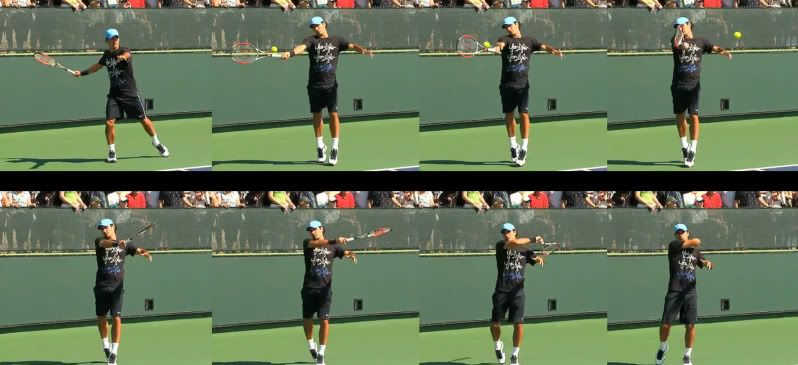
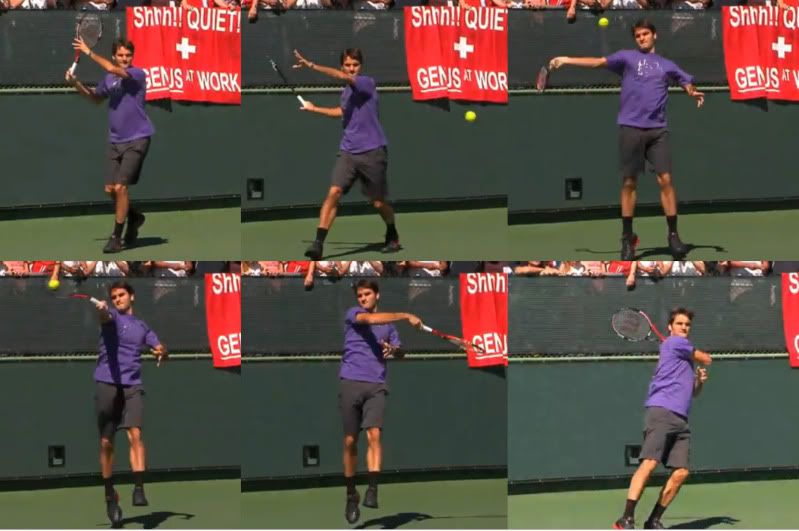
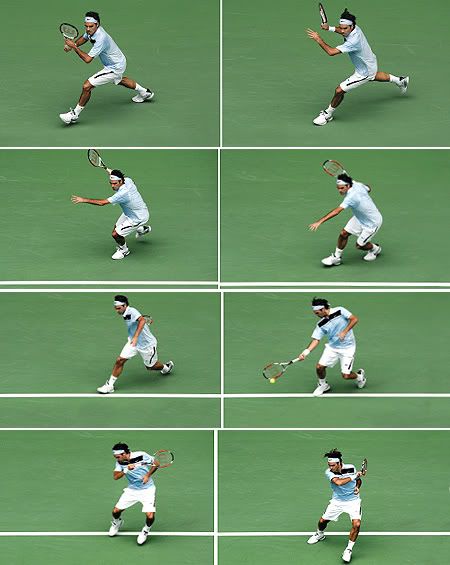
Here is Roger's regular forehand. Many people use it as inspiration in their own forehand.
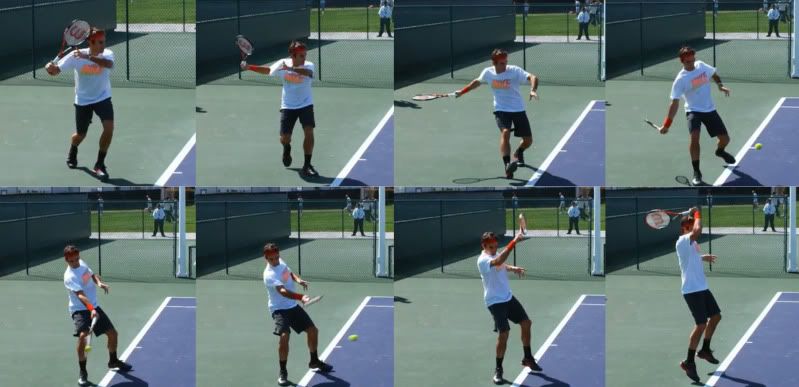
So that's all you need for a killer forehand...Right? But that only covers the forehand from his waist to his chest. You might want to learn how to deal with them around the shoulders.

But what if you have a really high bounce and it goes over your head?

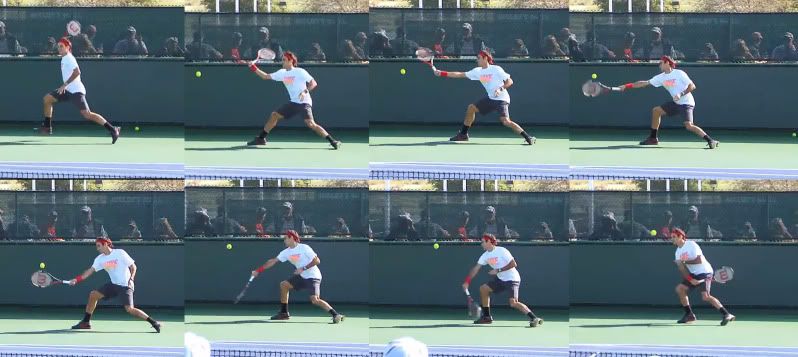
What if you have a low bounce?

What if you can't reach it with a normal forehand and have to slice?

What if you want to come to the net and you need to hit an approach shot?

What if the ball is low on the approach shot?

I won't even get started on the different forehand volleys. Or the backhands, or the serve, or the return of serve, or the slice, or specialty shots. And I'm not exaggerating this. Federer is special but all of the shots I listed are shots you will have to learn if you want to progress in this game. The sooner a club player can realize this, the more dangerous he/she becomes. Good luck!

Monday, April 12, 2010

It's Not My Game...It's the Weather (Dry Heat)

First I want to address the issue of pollen. Pollen should only really be a factor if the wind kicks up. If it is humid and heavy, the pollen should not bother you so much. But the dry, hot days with a little wind are what makes it bad. Balls pick up and disperse pollen every time they hit something (IE the ground and your racket) so bring some extra tissues and take your antihistamine.

Dry Heat

http://static.guim.co.uk/sys-images/Sport/Pix/pictures/2009/1/26/1232964954085/Victoria-Azarenka-of-Bela-001.jpg

In 2009, Victoria Azarenka had to play Serena Williams in the Australian Open. At the beginning of the match, Azarenka was firing backhands and forehands and Serena was running all over the place. About midway through the first set, you can see her stomach working hard to pull in air. Azarenka won the first set. Shortly as the match went on, Azarenka started weakly stumbling and almost losing her balance frequently. Eventually she retired from the match. She was ill, and combined with the heat of Australia, she didn't stand a chance.

Dry heat is killer. You know it's hot mentally. You feel the sun. However you don't seem to sweat. Well you are sweating. But the heat is evaporating your sweat before it beads up and travels down your face.

Dry Heat is bad but if you are the type of player that uses spin or hits the ball really flat and hard, your skills will be magnified. Normally, depending on how hard you and your opponent are hitting the ball, the ball will lose pressure. With dry heat you can enjoy an actively bouncing ball much longer. The balls also stay good for practice as well.

So here is how you beat the dry heat:

1. Hydrate Early - Drink a lot of water the night before if you have a day match and in the morning for an afternoon match. If you are going to drink any diuretics (drinks that dehydrate ie soda/alcohol/coffee) it is more essential to drink water. Pack some extra water and make sure you do not leave it out in the sun while you are playing. The sun will heat up your water just like leaving a dog in a car. Make sure you drink some water every chance you get. If you feel dehydrated then it is too late.

2. Cover up - Unless you are practicing, I think that showing bare arms is a mistake. The sun will hit the exposed areas and will heat you up. The same thing with your head. The body will steal energy from your game in order to cool itself down.

3. Focus - It is a lot easier to become lightheaded when the heat is high. Try to pay attention to how you feel an manage yourself accordingly. If you find yourself getting a little dumber than usual, eat some food, pour a little water on your neck and use the full 30 seconds in between points to towel off and take stock in your condition.

4. Liquid food - Make sure that when you eat food, bring something that doesn't require too much chewing. If you get dehydrated, your mouth will not produce the required saliva you need to break down to food. Bananas are excellent. A non-carbonated sports drink should help. There are some sports pastes that you can use also.

Sunday, April 4, 2010

It's Not My Game...It's the Weather (Cold)

http://www.birminghamlights.com/houses/brook_highland/Dscn0436.jpg

If you are like me you will play tennis in the cold even if you do not like it. Cold weather takes bounce out of the ball. So if you are used to hitting the ball with a little pace, you can forget about it.

The cold weather also can freeze you making it harder to warm up and easier for you to get injured. No fun there!!

BUT you are addicted to tennis or maybe you signed up for a league and you do not want to quit so here is how you overcome the colder temperatures.

1. Get out the long johns! Most people naturally want to layer their clothes to keep warm. I try not to layer so much. Personally I put on long underwear pants to warm my legs up quickly. I do not want to wear shorts because I do not want a changeover to take all the warmth out of my legs for the next game.

For the top half of my body I wear a tight shirt underneath and maybe a sleeveless undershirt. Then I put on a big sweatshirt. I don't want to layer so much up top that I sweat or stifle my swing motion in some way. I am a big guy and this is how it works for me. However, if you are a different body type, you might not have a problem hitting a forehand or a serve. So experiment. However I do STRONGLY recommend not exposing any skin to the elements if you can.

2. Spin works wonders. You want to play with the spins more than usual. Slice serves and flat serves are good. The ball will not bounce enough for anyone to be very aggressive so do not worry so much about people hitting winners. Keep the shots low and you can take all the patience out of an aggressive player.

3. Get to the net. The most aggressive shot you can hit in this weather is your serve. So if you can get to the net behind it you could have some success. Go more for angles on your groundstrokes when you hit an approach shot. Smacking balls deep will cause you to overcook shots.

4. Bring something warm to drink.

The cold is something that we all have a preference about. with a little experimentation you can keep your condition stable and play at an optimum level.

Good luck!

Tuesday, March 30, 2010

It's Not My Game...It's the Weather (Humid)

http://www.timesonline.co.uk/multimedia/archive/00474/nadal385_474640q.jpg

Humid weather, sometimes called "heavy conditions" can be deceptively difficult. Scientifically speaking, there just happen to be more water molecules in the air. So the ball has to push through more molecules and it has absorbed molecules too. Imagine if you were going to play tennis underwater. Think of how hard it would be to hit a ball over the net. How hard it would be to run. Now imagine the ideal dry and hot conditions. Mix the two together.

Regularly speaking, the ball is heavier. So it will be harder to hit and it won't bounce as high.

You and your opponent will be experiencing the heaviness too. Which means that you will be using more energy. Your sweating will also increase because the humidity and the normal sweat will act as a barrier, keeping heat from escaping your body at a normal rate. Which means more sweat still.

Water is a really powerful molecule. Here is how you counteract:

1. Spin is your friend. Humidity will make the ball bounce lower. So get ready to hit a heavily spun ball. A higher percentage of balls will be too low for you to hit straight into the court flat. So it is a good rule to spin all the balls unless they are really high. Legs don't fail me now!!

2. Serve aggressively. You can hit more flat serves and slices. In these conditions, the ball should fall into the box a little more. Just toss a little higher to counteract the ball heaviness.

3. Bring more water. If you sweat, you will lose more fluids than you are used to. Make sure that you bring extra to replace.

4. Bring more towels and shirts. Double up on the sweat bands and headbands/hats. Managing your sweat will start to become an issue. If you sweat a good amount in normal conditions, bring another shirt or two. Maybe a complete change of clothes. The accumulation of sweat will weight you down if you aren't careful.

REMEMBER: Your body controls it's temperature by sweating and shivering. So make sure that you create as many spaces for your body to sweat. The sun is not an issue so show a little more skin and dry yourself off meticulously between points. By letting heat escape from your body faster, you fight fatigue.

Good Luck

Friday, March 19, 2010

It's Not My Game....It's the Weather! (Wind)

Unless you are rich enough to play all your matches indoors, you will have to deal with the weather at one point or another. It is very important that you recognize the weather as another player in your game because it is always trying to impose it's will. Since the spring seems to have the most unpredictable weather in Georgia, it is a good time to discuss this. Starting with the WIND.

Wind


Indian Wells 2009 was the wierdest day of finals I ever saw!  They don't postpone matches based on wind.

The wind is a very tricky foe. It turns on and off without warning and seems to effect each side at different times. It can also come from any direction. In general you want to play a conservative 3/4th power game and use more spin.

Stay Mentally Strong

You cannot control the wind. So do not let it get you upset.

Different Wind Directions

Oh man! Depending upon the direction wind is blowing, the ball will break to that effect. If the wind is blowing into your back then the ball will stop short. If its to your front, the ball will move faster and deeper into the court towards you. If the wind is breaking left or right then the ball will move left or right. It is really important to notice this early and make the adjustments in your game.

Footwork

Footwork is the key in most of tennis. But it REALLY matters when it is windy. Take note of the wind early and try to tell yourself what the ball is going to do before the game starts. Then get the jump on the ball. If the wind breaks to the left, stand in a spot where you can lean and hit a shot that jumps to the left. If the wind is to your back, play up in the court. Etc.

Serve

Forget about your power serve. The wind will move your toss all over the place. Spin serves are the key since you have a little more time to judge where the ball is in the toss.

Ground Strokes

You will want to work your topspin as much as you can if the wind is to your back. If you hit the ball flat, it will be pushed long. Hit out on the ball if the wind is to your front. If you can, work the slice in to save you some time. If the wind is blowing left or right, move the court in your mind a few feet in the direction the wind is moving.

Volleys

Generally if you can hit good enough shots to come to the net with, the wind is not enough of a factor. But if you are brought to the net, make sure you play your volleys light and short around the service line and be vigilant for out balls.

If you accept the wind is going to make your day difficult and plan accordingly, you will play with more confidence. The trick to it is handling the wind better than your opponent and not being too aggressive.


Tuesday, March 2, 2010

The Great Equalizer

Say you are a good counterpuncher. In other words you use your patience and consistency and rely on unforced errors (you counter the other players punches). I mean you are HARDCORE. If tennis was COLLEGE you would have a PhD in counterpunching. I think you get the idea.

NOW say you have a match against another counterpuncher with a PhD from a college of equal or greater value.

Sweet! THAT means that you will have your patience and fitness tested to the LIMIT. Worse yet, what if the person stepping out there against you has HUGE quads. Suggesting that they could go all day...
http://www.factmonster.com/images/Michael_Chang.jpg
Now THOSE are quads.

Maybe you are an average size but your opponent is skinnier and lighter. Taking less energy to get to a ball than you spend for the same endeavor.
http://www.whatsalltheracquet.com/archives/pictures/Anna-Chakvetadze.jpg
What do you do when your opponent is better at your game that YOU are? You find an equalizer. And equalizer (and I'm coining this phrase) is basically a technique that you borrow from another playing style. It is something that you are good at that you don't really need unless it is clear that you will not win the match doing your regular play.

As an example, being a counterpuncher is a safe style. You keep the ball in play and try to draw unforced errors. But when the other player is better at keeping the ball in play you might have to learn how to construct points like an all around player and finish things off at the net. OR you could learn how to mix spins like a junk baller to facilitate getting errors from your opponent.

Whatever it is, all great players have the equalizer. The secondary style. Roger Federer has a great aggressive all court game. But he counterpunches unbelievably well.

Serena Williams has an AWESOME power game but occasionally you see her come to the net.

If you don't have a second game, you had better bring a VERY VERY strong first game. And you had better be prepared to do it all the time whatever it takes. If you love power and you hurt your shoulder, you had better be prepared to hit through it. If you like retrieving balls and getting them back and you pull a leg muscle, get ready to do your fastest limp. It's that simple.

Tennis is FULL of players that were very one dimensional and changed because they were getting older and couldn't afford to spend the energy. No one can escape this and still be at an equally competitive level.

Good Luck!

Sunday, January 24, 2010

Follow The Bouncing Ball (Pound Crosscourt)

http://blog.tennis-open.net/wp-content/uploads/2009/06/marat-safin-2.jpg
My all time favorite player is Marat Safin. I didn't like all the drama he created on the court (all the broken rackets and the long patches of playing badly). I really liked his playing style. Marat Safin (mah RAHT SA fin) in his early career had great strokes on both sides. His backhand was more reliable but he had a pretty good forehand too. He also had the ability to hit a better and better stroke as the rally went on.

His strategy was super simple. Hit your shots crosscourt. Then, when there is an opportunity, hit down the line. By opportunity, I mean that the ball is high enough over the net to hit a speedy flat ball. No one seemed to be able to stop this strategy. Because Marat hit such strong groundstrokes, people couldn't go down the line on him very easily. When they tried he would run the ball down and go crosscourt....this time to the other side of the court, insuring that his opponent would run way more than him.

Plus knowing in the back of your mind that he was setting you up to hit the winner down the line gave you no comfort. The only way you could disrupt the pattern would be to come to the net. But when would you hit a solid enough shot to do that and how many times do you think you could do it?

Quick explanation of court geometry: crosscourt means hitting the ball diagonal. If you were both right handed players, your forehand would be to his forehand. Down the line is the opposite. You hit your forehand to his backhand.

http://newsimg.bbc.co.uk/media/images/40790000/gif/_40790612_court_dimensions2.gif

The net is lower in the middle (3 ft) and the length is longer diagonally (82.5 ft). The net is higher on the sides (3.5 ft) and the length is shorter (78 ft). I had to use that old Pythagorean Theorem (27 squared + 78 Square = 82.5 Squared).

So if you are able to hit harder and lower crosscourt knowing that you have extra room to make a mistake. Hitting close down the line would be difficult to do if you are hitting a lower ball.

So lets see this in action shall we? The examples of the pattern are at 1:04, 3:10. 4:05, 5:23

This pattern is for when you feel like your groundstrokes are strong enough to wear your opponent down. It's one of those strategies that pay more dividends as the match goes on.

Tuesday, January 19, 2010

Follow the Bouncing Ball (Protect Your Weaker Backhand)

OK, so in the last blog we covered how to attack the weaker side. In this one we cover how to DEFEND the weaker side. The strategy is different for both wings. So I will split it up.

Defend the Backhand

The usual defense for protecting the backhand is to run around it and hit a forehand. But every bad backhand needs to be consistent eventually.

Beginner: Cheat. Just stand way over to your backhand side. Your opponents will not be so good at aiming so the chances are that they will probably make the errors trying to find your backhand or trying to exploit all the space you left open on your forehand side. When they DO find the backhand, just float it back. Try to hit it to their weaker side.

Intermediate: Cheat less. Opponents will aim a little better so start working on improving your footwork. Once you improve that, you won't have to cheat as much. Some stuff to consider in your practice sessions:
  • Learn to hit a forehand from corner to corner from anywhere on the court. There might be situations in which you run around your backhand so much you end up way on the backhand corner. So learn how to be comfortable.
  • Learn a consistent slice crosscourt (from your backhand to his backhand assuming your a both right handed).
  • Learn how to serve well enough so you only have to hit forehands on your serving points. Learning a slice serve out wide will help get more balls to your forehand.
Advanced: At the advanced level you have to do one of two things: 1. Learn how to move so well that you pretty much ONLY hit forehands OR 2. Use the slice open up opportunities for your forehand. I suggest the latter. You can really tire yourself out jumping all over the court. You will also start to prefer clay over hard simply because you have more time to run around your backhand. There is no real practice for that. You just always hit a forehand.

The slice that you learned as an intermediate is very important. It's great for defense and doesn't require great footwork to hit. If you keep the slice LOW, it is hard to attack. Your opponent will have to pick it up off the ground and hit a topspin shot to do it. He will also have to hit the ball over the low part of the net or risk hitting a topspin shot over the high part which will give you enough time to get your forehand into play. Here is how you use that to your advantage:
  1. Mix it up - Roger Federer mixes up the topspin backhand with the backhand slices. Since he has a one handed backhand, it is fairly easy for him to disguise which one he is using. At Some point he will use this sharp low slice that causes the opponent to leave the baseline uncomfortably. The reply leaves the person off balance and hitting the ball either in the middle of the court cross court again. Either way Federer has just opened up the court for an easy winner. He is being proactive. Examples in the video are at 4:20 and 4:49.
http://cache2.asset-cache.net/xc/79057795.jpg?v=1&c=IWSAsset&k=2&d=77BFBA49EF87892155F29F61288AC1CA8D7DB6BBC13BB6F2D4424C1B82D9591C0A14FDF34D0303A5http://cache4.asset-cache.net/xc/79205975.jpg?v=1&c=IWSAsset&k=2&d=77BFBA49EF87892155F29F61288AC1CA84FEEC58AF9217FD22F4F090A4772C3AD1479998EB2063DD
Federer's backhand preparation. Topspin on the left, slice on the right.


2. Wait for the opening - Fernando Gonzalez simply just hits crosscourt slices until the other guy messes up. His forehand is BIG. Plus he knows that most people are going to his forehand when they hit a shot coming to the net. So he takes off running a second early. Examples of this are at 0:26, 3:03 and 3:40


Follow the Bouncing Ball